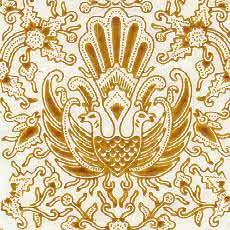
 | Step 1The first wax is applied over the penciled-in outline of the pattern. Almost always the original cloth is white or beige. |
 | Step 2The cloth is dyed in the first dye bath. In this case the first dyebath is indigo blue. The area of the cloth where the wax was applied in Step 1 will remain white. |
 | Step 3Second application of wax is applied. In this case it is a dark brown color. A poorer quality of wax is used to cover larger areas of cloth. The darker color helps to differentiate it from the first wax applied. Any parts that are covered with this wax application will remain the indigo color. |
 | Step 4The cloth is dyed in the second dye bath. In this case it is a navy blue. Any areas that are not covered by wax will become dark blue. |
 | Step 5All the wax that has been applied thus far is removed. This is done by heating the wax and scraping it off and also by applying hot water and sponging off the remaining wax. |
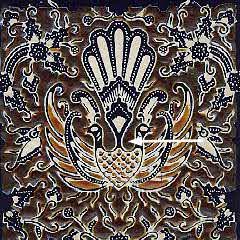 | Step 6Wax is applied to the area of the fabric that the artist wishes to remain the indigo blue color. |
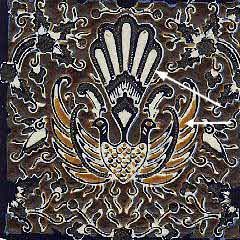 | Step 7Wax is applied to the area of the fabric that the artist wishes to remain white. |
 | Step 8The fabric is submerged in the final dye bath. In this case it is brown. Any areas of the cloth that have not been covered with wax will become brown. |
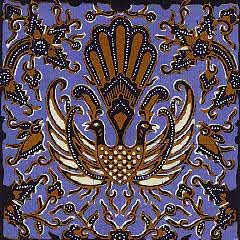 | Step 9The finished cloth after all of the wax has been removed. |
Friday, 13 November 2015
Batik

Puff Binder
Puff binding- The Selectasine range of binders and pigments offer the textile artist a variety of options for screen printing and painting.
This test shows how the Selectasine Puff Binder combined with Selectasine Pigment performs on finely woven cotton fabric.
The pigment colour Fiery Red was combined with the puff binder at approximately 1 part pigment to 20 parts binder. The concentrated pigments are supplied in a liquid state as "pigment in dispersion" (i.e. the pigment is still a solid, though minute, and has not been dissolved into the liquid), this makes them easy to stir into the binder. These pigments can be used to create screen ink, paint, and to colour pulp in hand paper making.
The pigment needs to be added to a binder if the solution is to used on fabric, paper, board or wood. The acrylic content of the binder makes a bond with fabric once the paint has dried and been fixed with. There are a choice of binders for creating different effects with the pigments.
The Selectasine Puff Binder inflates as heat is applied making the painted or printed item slightly raised on the surface.


| The solution painted onto fabric, note that more paint has been applied to the top circle. |
Allow the solution to dry thoroughly and then sandwich between two sheets of cotton before ironing on the reverse of the print. The iron needs to be very hot and the steam switched off.

| The solution has puffed up. |
The puffed solution gives a slightly matt finish and the colour has dulled slightly. The top circle shows the potential for the binder to puff up quite substantially. Applying the 'ink' through a screen will make the coverage more even and subsequent layers can be printed on top before fixing.
The fabric puckers slightly beneath the puffed solution. The more solution that is applied, the more the fabric will pucker from beneath, offering exciting opportunities for creating dimpled and textured fabric.
The fabric puckers slightly beneath the puffed solution. The more solution that is applied, the more the fabric will pucker from beneath, offering exciting opportunities for creating dimpled and textured fabric.
| The solution has puffed up. |
The puffed solution gives a slightly matt finish and the colour has dulled slightly. The top circle shows the potential for the binder to puff up quite substantially. Applying the 'ink' through a screen will make the coverage more even and subsequent layers can be printed on top before fixing.
The fabric puckers slightly beneath the puffed solution. The more solution that is applied, the more the fabric will pucker from beneath, offering exciting opportunities for creating dimpled and textured fabric.
The fabric puckers slightly beneath the puffed solution. The more solution that is applied, the more the fabric will pucker from beneath, offering exciting opportunities for creating dimpled and textured fabric.
Subscribe to:
Comments (Atom)