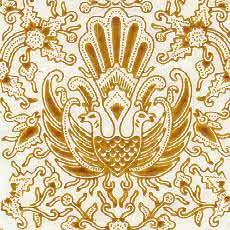
 | Step 1The first wax is applied over the penciled-in outline of the pattern. Almost always the original cloth is white or beige. |
 | Step 2The cloth is dyed in the first dye bath. In this case the first dyebath is indigo blue. The area of the cloth where the wax was applied in Step 1 will remain white. |
 | Step 3Second application of wax is applied. In this case it is a dark brown color. A poorer quality of wax is used to cover larger areas of cloth. The darker color helps to differentiate it from the first wax applied. Any parts that are covered with this wax application will remain the indigo color. |
 | Step 4The cloth is dyed in the second dye bath. In this case it is a navy blue. Any areas that are not covered by wax will become dark blue. |
 | Step 5All the wax that has been applied thus far is removed. This is done by heating the wax and scraping it off and also by applying hot water and sponging off the remaining wax. |
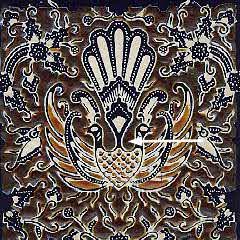 | Step 6Wax is applied to the area of the fabric that the artist wishes to remain the indigo blue color. |
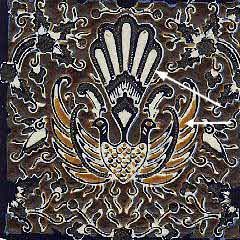 | Step 7Wax is applied to the area of the fabric that the artist wishes to remain white. |
 | Step 8The fabric is submerged in the final dye bath. In this case it is brown. Any areas of the cloth that have not been covered with wax will become brown. |
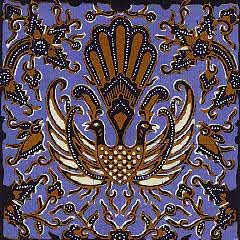 | Step 9The finished cloth after all of the wax has been removed. |
Friday, 13 November 2015
Batik

Puff Binder
Puff binding- The Selectasine range of binders and pigments offer the textile artist a variety of options for screen printing and painting.
This test shows how the Selectasine Puff Binder combined with Selectasine Pigment performs on finely woven cotton fabric.
The pigment colour Fiery Red was combined with the puff binder at approximately 1 part pigment to 20 parts binder. The concentrated pigments are supplied in a liquid state as "pigment in dispersion" (i.e. the pigment is still a solid, though minute, and has not been dissolved into the liquid), this makes them easy to stir into the binder. These pigments can be used to create screen ink, paint, and to colour pulp in hand paper making.
The pigment needs to be added to a binder if the solution is to used on fabric, paper, board or wood. The acrylic content of the binder makes a bond with fabric once the paint has dried and been fixed with. There are a choice of binders for creating different effects with the pigments.
The Selectasine Puff Binder inflates as heat is applied making the painted or printed item slightly raised on the surface.


| The solution painted onto fabric, note that more paint has been applied to the top circle. |
Allow the solution to dry thoroughly and then sandwich between two sheets of cotton before ironing on the reverse of the print. The iron needs to be very hot and the steam switched off.

| The solution has puffed up. |
The puffed solution gives a slightly matt finish and the colour has dulled slightly. The top circle shows the potential for the binder to puff up quite substantially. Applying the 'ink' through a screen will make the coverage more even and subsequent layers can be printed on top before fixing.
The fabric puckers slightly beneath the puffed solution. The more solution that is applied, the more the fabric will pucker from beneath, offering exciting opportunities for creating dimpled and textured fabric.
The fabric puckers slightly beneath the puffed solution. The more solution that is applied, the more the fabric will pucker from beneath, offering exciting opportunities for creating dimpled and textured fabric.
| The solution has puffed up. |
The puffed solution gives a slightly matt finish and the colour has dulled slightly. The top circle shows the potential for the binder to puff up quite substantially. Applying the 'ink' through a screen will make the coverage more even and subsequent layers can be printed on top before fixing.
The fabric puckers slightly beneath the puffed solution. The more solution that is applied, the more the fabric will pucker from beneath, offering exciting opportunities for creating dimpled and textured fabric.
The fabric puckers slightly beneath the puffed solution. The more solution that is applied, the more the fabric will pucker from beneath, offering exciting opportunities for creating dimpled and textured fabric.
Monday, 5 October 2015
Workshops
Ceramics- In ceramics with Debra first she explained what we was doing and we was sculpting ourselves and making our sculpture in proportion etc, we had to make sure there was no air bubbles in the clay and she also taught us to use the different equipment and also explained about the many different artists there is that do ceramics etc.
Print Making- In Print Making with Jessica we had to design a piece of Lino to do some printings with, we had to base it all on '' The World We Live In...', so we used our sketch books we designed to help us with ideas etc, we also had to interpret other artists to do with print making into our designs to do our prints. Next we had to cut into the lino with the carving tools to make the outline and block colour, after that we had to roll out the ink onto a flat clean surface and then roll it onto our lino and lay it flat on the Print beds and put a clean piece of paper on top of it and cover it and spin the roller to roll on it, then once the lino and paper is at the other side of the print bed you then clean the lino with warm water and put your print on the drying rack to dry.
Print Making- In Print Making with Jessica we had to design a piece of Lino to do some printings with, we had to base it all on '' The World We Live In...', so we used our sketch books we designed to help us with ideas etc, we also had to interpret other artists to do with print making into our designs to do our prints. Next we had to cut into the lino with the carving tools to make the outline and block colour, after that we had to roll out the ink onto a flat clean surface and then roll it onto our lino and lay it flat on the Print beds and put a clean piece of paper on top of it and cover it and spin the roller to roll on it, then once the lino and paper is at the other side of the print bed you then clean the lino with warm water and put your print on the drying rack to dry.
Visits to the Cooper Gallery/ The Civic and Experience Barnsley (Town Hall)
We visited the Cooper Gallery at the start of this project and we had a look around the different exhibitions and take notes of how the exhibitions where laid out and how people had presented there work. We also learnt about a lot of different types of artists.
We also visited The Civic and Experience Barnsley(Town Hall) and the same basically applied there as well. We learnt as well that all 3 galleries are now all booked up till July/August 2016.
We also visited The Civic and Experience Barnsley(Town Hall) and the same basically applied there as well. We learnt as well that all 3 galleries are now all booked up till July/August 2016.
Wednesday, 17 June 2015
Card Board city- time lapse
https://m.facebook.com/groups/809942145754130?ref=m_notif¬if_t=group_activity&actorid=552282695&feed_ufi=comments
https://m.facebook.com/groups/809942145754130?ref=m_notif¬if_t=group_activity&actorid=552282695&feed_ufi=comments
Tuesday, 9 June 2015
Evaluation- card board city
Cardboard city is a unit in which we would use time based media to create an entire city out of, well, cardboard boxes, we did this by working in pairs, whiloe still using our own abilities to solve problems to do with working on how the pieces are presented, we were put into pairs to create a box building where we would use our own ideas, primary research from nearby architecture and secondary research on other artists who use time based media.
This unit has had many difficulties, mostly on the technical side of things due to my phones incapability to add photos or to even connect with the blog, which even now I am struggling to work around, which is where I felt at a disadvantage compared to other students as they were all able to do it on their fancy iPhones etc amd it was extrememly frustrating not having all the pictures i needed, and then most of then wouldnt work. This unit has made me feel outdated because i really struggled with being digital even though it is a major component of the unit, i would have prefered using a sketchbook for annotation. However I've learnt New techniques over this unit, it has opened my eyes as to how work can be presented in a multitude of ways, such as using new medias such as sculpting and creating with cardboard boxes, the positioning of everything, but mostly how to present your work in the most outwordly, creative ways possible. this included using light and dark to create an atmosphere, such as when we were in the drama studio we turned out the lights and the art had a new meaning and a bigger depth. having had Jennifer guide us through this was a huge help as its what she does for a living, working with time based media, which is contemporary art mixed with the use of digital media, because without her suggestions and helping me improve i wouldnt have accomplished as much, for example she guided me through making edits to my blog.
At the start of the project i was skeptical as to what i would be able to do with the skills i already possessed as none of them included working with 3d media such as boxes, so figuring a way around working on different surfaces was difficult but i did manage to solve this by treating as a weirdly shaped canvas, and it worked. Getting primary research was actually more fun than i had anticipated, being able to go out, explore and record what i saw, specifically when taking images of the buildings near college gave me a sense of creative independenc because i could take pictures of what inspired ME and what gave me ideas, and be able to explain it to others. This helped to contribute to a concept i already had, which was modern meets classic, which came to me with our secondary research on borofsky/boltanski as they are modern/classic artists. this led me to an idea of a plain background that was square and resembled an everyday manhattanesque skyline, but had strong detail painted onto the front which helped to contrast and make you think about it, at first it was a challenge as it stuck out and made it seem wrong, but as we worked into it with different medias such as guttering from textiles, which gave it a higher 3d relief, it was more harmonious. when it came to the day of putting everyones boxes together in which it would become a city, and as we were in a classroom in which half the walls were glass panes, we took advantage and created an atmosphere with shadow/ light play in this instance. we used different coloured acetate and stencils of buildings and put them on the windows which gave the room a more lively, genuine city like vibe which was really cool. The city when put together looked incredible and it all worked together. overall this unit has taught me the most skills, took me out of my comfort zone the most, and really tested my creative ability and my technological patience.
This unit has had many difficulties, mostly on the technical side of things due to my phones incapability to add photos or to even connect with the blog, which even now I am struggling to work around, which is where I felt at a disadvantage compared to other students as they were all able to do it on their fancy iPhones etc amd it was extrememly frustrating not having all the pictures i needed, and then most of then wouldnt work. This unit has made me feel outdated because i really struggled with being digital even though it is a major component of the unit, i would have prefered using a sketchbook for annotation. However I've learnt New techniques over this unit, it has opened my eyes as to how work can be presented in a multitude of ways, such as using new medias such as sculpting and creating with cardboard boxes, the positioning of everything, but mostly how to present your work in the most outwordly, creative ways possible. this included using light and dark to create an atmosphere, such as when we were in the drama studio we turned out the lights and the art had a new meaning and a bigger depth. having had Jennifer guide us through this was a huge help as its what she does for a living, working with time based media, which is contemporary art mixed with the use of digital media, because without her suggestions and helping me improve i wouldnt have accomplished as much, for example she guided me through making edits to my blog.
At the start of the project i was skeptical as to what i would be able to do with the skills i already possessed as none of them included working with 3d media such as boxes, so figuring a way around working on different surfaces was difficult but i did manage to solve this by treating as a weirdly shaped canvas, and it worked. Getting primary research was actually more fun than i had anticipated, being able to go out, explore and record what i saw, specifically when taking images of the buildings near college gave me a sense of creative independenc because i could take pictures of what inspired ME and what gave me ideas, and be able to explain it to others. This helped to contribute to a concept i already had, which was modern meets classic, which came to me with our secondary research on borofsky/boltanski as they are modern/classic artists. this led me to an idea of a plain background that was square and resembled an everyday manhattanesque skyline, but had strong detail painted onto the front which helped to contrast and make you think about it, at first it was a challenge as it stuck out and made it seem wrong, but as we worked into it with different medias such as guttering from textiles, which gave it a higher 3d relief, it was more harmonious. when it came to the day of putting everyones boxes together in which it would become a city, and as we were in a classroom in which half the walls were glass panes, we took advantage and created an atmosphere with shadow/ light play in this instance. we used different coloured acetate and stencils of buildings and put them on the windows which gave the room a more lively, genuine city like vibe which was really cool. The city when put together looked incredible and it all worked together. overall this unit has taught me the most skills, took me out of my comfort zone the most, and really tested my creative ability and my technological patience.


Glossary- Card Board city
Glossary of terms
AVANT GARD:
Applied to art, avant-garde means art that is innovatory, introducing or exploring new forms or subject matter
CARL ANDRE BRICKS
Kinetic art:
is art that depends on motion for its effects
e.g. Alexander Calder- Antennae with Red and Blue Dots 1960
Installation art:
is used to describe mixed-media constructions or assemblages usually designed for a specific place and for a temporary period of time
e.g. Cornelia Parker Cold Dark Matter: An Exploded View 1991 & Rachel Whiteread
Figurative art
Describes any form of modern art that retains strong references to the real world and particularly to the human figure e.g. Picasso
Abstract art
is art that does not attempt to represent an accurate depiction of a visual reality but instead use shapes, colours, forms and gestural marks to achieve its effect; it could be based on a subject such as a figure, landscape or object or may have no source at all in the external world e.g. : Kandinsky
( https://mymoodle.barnsley.ac.uk/course/view.php?id=248)
Liner
-Someone who makes or draws lines, useful for mark making
Stop motion : Onion skinning
-onion skinning is a process on stop motion that allows the animator to view multiple frames at once
Meditate and synthesis an image
-I couldnt find anything on this really, but from what i can guess and the way i see it, it means to look at an image and really think about it and put it into your own words?
silhouette
Zoetrope: Reciprocal Action & Persistence of vision
-The zoetropes motion helps to create the illusion of living animation, but it is just drawings that create a fluid animation when in motion
-The zoetropes motion helps to create the illusion of living animation, but it is just drawings that create a fluid animation when in motion
Objets trouvés
-it is a phrase used to describe art created from everyday objects that have been altered in some way that dont have an art function, picasso was the first person to try this by when he pasted a printed image of chair caning onto his painting titled Still Life with Chair Caning
-it is a phrase used to describe art created from everyday objects that have been altered in some way that dont have an art function, picasso was the first person to try this by when he pasted a printed image of chair caning onto his painting titled Still Life with Chair Caning
Theater d'ombre
-in basic terms it is shadow play, using light to tell a story, and has been used consistently throughout the project.
-in basic terms it is shadow play, using light to tell a story, and has been used consistently throughout the project.
Card board city- time based media
WHAT ARE SOME EXAMPLES OF TIME-BASED MEDIA WORKS?
Typical examples of this category are video and sound artworks, film or slide-based installations, software-based art and other forms of technology-based artworks, many of which can also be regarded as installation art. The Guggenheim collection contains several hundred time-based media artworks, including works by Marina Abramovic, Matthew Barney, Bruce Nauman, Nam June Paik, Jason Rhoades, and many other important contemporary artists.
Tuesday, 2 June 2015

FMP- Artist research- Sue Coe, Gale
Sue Coe:
Sue Coe is an English artist and illustrator, working primarily in drawing and printmaking, often in the form of illustrated books and comics. She grew up close to a slaughterhouse and developed a passion to stop cruelty to animals.

Gale Hart:
Biography
A childhood fascination with creating objects out of nuts, bolts, scrap metal and
wood evolved into an intensely energetic creative drive. Gale Hart began her
career with an enduring passion to compile components into a whole. From
monumental canvases to meticulous graphite drawings, Hart's repertoire of visual
images grabs, engages and speaks volumes about universal humanity.
A narration characterized by humor, angst and sarcasm presents itself through a
constantly evolving cast of characters. Reminiscent of a candid snapshot, Hart
captures an attitude at a particular place and point in time. The specifics of a
personality are not as important as the condensed essence or vitality of expression.
Through direct frontal gaze and exaggerated facial expressions, Hart conveys the
difficulties of human interactions and the challenges of interpersonal
communication.
The paintings initiate a visceral discourse with the viewer - the viewer is intrigued
and pulled into the narrative of the subject matter. Hart implements the use of
rhythmic geometric elements as a means of visual navigation. This technique of
unification formalizes the composition and mitigates visual and emotional agitation.
Color as a void saturates the background of the paintings against which the intense
hues of the figures emanate to elicit tension. Awkward color combinations distort
and disarm the eye, yet concurrently assist in the comprehension of the work.
Hart's sculpture parallels her paintings with the visual language remaining constant:
narrative composition, ordered geometry and color choices. Validating the instincts
that launched her creative career, found objects continue to hold limitless
possibilities and appeal. Hart seamlessly marries incongruent materials creating
mirthful yet perplexing personages.
Hart approaches all of her work with an eye toward artistic sensibility and technical
expertise. Never sure what the next series will bring - Hart states: Keeping my art
fresh is equally as important as my need to make art.

Born: November 28, 1951 (age 63), Tamworth, Staffordshire
Artwork: Murder in the Gulf, Wall Street Bloodbath, more
Movies: Comic Book Confidential
Education: Chelsea College of Arts, Royal College of Art
Gale Hart:
Biography
A childhood fascination with creating objects out of nuts, bolts, scrap metal and
wood evolved into an intensely energetic creative drive. Gale Hart began her
career with an enduring passion to compile components into a whole. From
monumental canvases to meticulous graphite drawings, Hart's repertoire of visual
images grabs, engages and speaks volumes about universal humanity.
A narration characterized by humor, angst and sarcasm presents itself through a
constantly evolving cast of characters. Reminiscent of a candid snapshot, Hart
captures an attitude at a particular place and point in time. The specifics of a
personality are not as important as the condensed essence or vitality of expression.
Through direct frontal gaze and exaggerated facial expressions, Hart conveys the
difficulties of human interactions and the challenges of interpersonal
communication.
The paintings initiate a visceral discourse with the viewer - the viewer is intrigued
and pulled into the narrative of the subject matter. Hart implements the use of
rhythmic geometric elements as a means of visual navigation. This technique of
unification formalizes the composition and mitigates visual and emotional agitation.
Color as a void saturates the background of the paintings against which the intense
hues of the figures emanate to elicit tension. Awkward color combinations distort
and disarm the eye, yet concurrently assist in the comprehension of the work.
Hart's sculpture parallels her paintings with the visual language remaining constant:
narrative composition, ordered geometry and color choices. Validating the instincts
that launched her creative career, found objects continue to hold limitless
possibilities and appeal. Hart seamlessly marries incongruent materials creating
mirthful yet perplexing personages.
Hart approaches all of her work with an eye toward artistic sensibility and technical
expertise. Never sure what the next series will bring - Hart states: Keeping my art
fresh is equally as important as my need to make art.


Friday, 8 May 2015
Evaluation
Throughout this FMP project we had to about freedom and do a 63 page book 10x10cm of different types of freedom(like the Magna Carta as it has 63 chapters. The Magna Carta is a charter of liberties to which the English barons forced King John to give his assent in June 1215 at Runnymede. : a document constituting a fundamental guarantee of rights and privileges. also through this project we had to create a final piece of what we thought freedom was.
I personally think this project went really well as I've got everything completed before deadline due to me going on holiday 12th may- 21st may. I started off doing my 63 pages and completed them in the first few weeks even though some weren't really up to standard I did get them done, the media I used on all the 63 pages were, acrylic paint, coloured pencil, water colours, I also sew into some pages, I also used biro pen and permanent markers and finally pen and water.
After I had done the 63 pages I had so many ideas what to do for my final piece I ended up starting a 2 and finishing them and didn't use them for my final piece them because I didn't feel asif they were really up to standard for a final piece. so I ended up using them as a development pages aswell as my pervious development sheets which I completed for my animal rights, since that's what I was aiming for my final piece and throughout this FMP project.
The use of media I used was a large variety but I believe I could've used it a lot better as I did rush my work. but I believe I worked very well with acrylic paint and coloured pencil.
In all honest I think I managed my time management quite well as I had to hand in my work 2 weeks early, I do feel asif I did rush abit but I wanted to get it all complete so I didn't get a referral.
I think my final piece went really well to say I only had a few ours to start and complete it, I decided to keep to my theme and do a person eye with birds and butterflies surrounding it to show animal rights. The media I used on this was water ink and coloured pencil and different shades of pencil and finally water colour. I personally think all my drawing skills and use of media contrasted really well.
My overall thought on this project are quite good, I feel asif it was a very good project to focus on because we did get to learn some new facts e.g. about the Magna Carta and about the different types of freedom. I really enjoyed this project aswell because we got left to write our own project proposal aswell as choosing our own questions for the evaluation. Even though it was a challenge I got it complete and im really proud
I personally think this project went really well as I've got everything completed before deadline due to me going on holiday 12th may- 21st may. I started off doing my 63 pages and completed them in the first few weeks even though some weren't really up to standard I did get them done, the media I used on all the 63 pages were, acrylic paint, coloured pencil, water colours, I also sew into some pages, I also used biro pen and permanent markers and finally pen and water.
After I had done the 63 pages I had so many ideas what to do for my final piece I ended up starting a 2 and finishing them and didn't use them for my final piece them because I didn't feel asif they were really up to standard for a final piece. so I ended up using them as a development pages aswell as my pervious development sheets which I completed for my animal rights, since that's what I was aiming for my final piece and throughout this FMP project.
The use of media I used was a large variety but I believe I could've used it a lot better as I did rush my work. but I believe I worked very well with acrylic paint and coloured pencil.
In all honest I think I managed my time management quite well as I had to hand in my work 2 weeks early, I do feel asif I did rush abit but I wanted to get it all complete so I didn't get a referral.
I think my final piece went really well to say I only had a few ours to start and complete it, I decided to keep to my theme and do a person eye with birds and butterflies surrounding it to show animal rights. The media I used on this was water ink and coloured pencil and different shades of pencil and finally water colour. I personally think all my drawing skills and use of media contrasted really well.
My overall thought on this project are quite good, I feel asif it was a very good project to focus on because we did get to learn some new facts e.g. about the Magna Carta and about the different types of freedom. I really enjoyed this project aswell because we got left to write our own project proposal aswell as choosing our own questions for the evaluation. Even though it was a challenge I got it complete and im really proud
Butterfly eye

Media used
-water colour pencils
-water colours
-colour pencils
-black biro
-shading pencils
This was another piece of my development work and I decided to stick to this idea throughout my whole project even though I did have so many different types of ideas. This was a class peers eye with butterflies and birds to represent freedom.
The pro's of this was I had a very good idea what I wanted to do for my final piece and I used my time management very well.
The con's of this development was that I had only used basic shading and coloured pencil and didn't really spend the time perfecting it to my standard. But I did put the time and effort into my final piece that came out extremely better than this piece of work.
Animal

The start of my final developments
I wanted to do half human and half animal as then I could interpret that hunting should be banned. But I couldn't add as much delete so I also scrapped this idea aswell.
Development

The media I chose to use on this development was 6B, HB, B shading pencils. I wanted to base my final piece on butterflies so I interpreted this and did add butterflies as well as birds for my final piece.
Development

The media used on this piece of development work was water colour. On this piece of work I tried to develop my water colour skills and try to blend them and make it look very vibrant and colourful, but one of my weak medias I struggle to use is water colour, so I did struggle on mixing the different colours, but this was only a development piece showing my creativity and ideas I may have used for my final piece.
Eyes

The media I used for these were:
-Coloured pencil
-Shading pencils
-Water colour
I started doing these eyes to show my development of drawing eye skills because for my final piece I did a giant eye, so I wanted to experiment and try different types of media which on my final piece I did include all three of these medias as I thought they'd work really well. But using them separate on 3 pieces of card didn't work that well as they look very dull and not that good to present, but they worked extremely good when all put together. The 3 types of media contrasted really well with each other.
The final piece


This is my final piece.
Media used-
-Water Ink
-colour pencils
-water colours
-different shades of pencils
-A2 piece of white cartridge paper
For my final piece I decided to keep to my original idea which was interpreting a class peers eye and using different types of butterflies and birds as silhouette's surrounding the eye to show freedom.
Firstly I applied water ink around the paper to give me a vibrant back ground, I then started to draw the outline of my eye and the birds and butterflies. Thirdly I then started adding colour pencil to the pupil and eye etc. Lastly, I used water colour to neaten the pupil and started the shading, erasing the lighter areas.
Throughout doing this final piece I did have many different ideas I wanted to explore but I decided to keep to this idea because it was my first initial idea.
The pro's of this final piece was that, I knew exactly what I was doing. I had all my primary information and secondary information as well; finally I did mix and use my media correctly throughout this as it was very important to get a 100% right as I didn't want to fail.
The con's of this final piece are I didn't really manage my time management as I did try to challenge my self too much and I did work on too small of a scale as I used A2, hypothetically speaking I think I should of really used an A1 piece of cartridge paper.
Thursday, 9 April 2015
Freedom
So for this project we have to create our own brief and and do a 63 paged sketch book with our own ideas, mind maps, explanations etc about freedom. we also have to create a final piece...so I'll doing daily blog entries to show what im doing and how im managing my time etc.
I decided to research six different types of freedom here are some and a definition:
Internal Freedom-The first and most basic type of freedom is embodied by the chap in jail. He has all his internal freedom, but no liberty. All normal human beings are born and remain free in the most important sense that they are forever and at every conscious moment freely-choosing beings, and every life is a delicate tapestry of millions of such personal choices, for better or worse. We cannot escape this kind of freedom even if we try, for we must then freely choose among means of escape, and so on. From this perspective we are condemned to be free, for even choosing not to choose is a choice. Internal freedom is of the greatest personal intimacy and secretiveness, indeed it is the hidden core of our being and unknowable by others. It distinguishes human beings from the animal kingdom, and from each other, and is the basis on which we are able to become moral - or a-moral, or immoral - beings. That is why some people call this moral freedom. But this kind of freedom is not in itself moral. Rather, it is the unique capacity we have to become moral or immoral according to how we use our freedom.
Self Freedom-Most of the world’s freedom talk, at least as found in the great religions and philosophical movements has had to do with freedom from ourselves, in the sense of learning how to escape the ever-present danger of enslavement by our own passions and ignorance. For the ancients, self-freedom had to do with the practice of self-control, restraint, and balance to achieve the admired master-slave relationship of soul over body that they were certain is essential for the good life. In modern times, however, this ideal has largely been turned upside down with the expression of strong feelings, of the “true self,” elevated to the superior position. The goal of this kind of freedom is therefore often expressed as the need “to find my self”(although no one ever seems to ask how we would know whether the self seeking, or the self sought, is the true self). At any rate, this inversion of the traditional relation of mind over feeling has according to many produced what our forbears would have called a disorder of the soul. But whatever may be the outcome, few moderns ever escape a lifelong dialogue with themselves on this kind of freedom.
External Freedom(Sometimes called “freedom from...”)-This refers to the normal and common freedoms expected in daily life, in most countries, throughout history. It is sometimes described as freedom from, because it implies immunity from undue interference by authority, especially by government. It is also sometimes called “negative freedom,” meaning freedom to do anything not forbidden by the laws (in contrast to a totalitarian system that says you may only do what is permitted by the laws). Many in the Western tradition consider this, in combination with Political Freedom, explained next, to be the most important kind of freedom, and in its earliest form, liberal constitutionalism was its political expression in the West. This political form has since the post WW II era mutated into a kind of egalitarian Statism.
Political Freedom (Sometimes called “freedom to...”)-Try to imagine a world in which you are ruled by a tyrant who lets you do what you want on Monday, but not on Tuesday, and so on, unpredictably. You would likely conclude that whatever your external freedoms may be, they are too unpredictable to be of any use. What we might call “political freedom” has to do with establishing certain predictable and permanent rights of action (whether we use them or not) and limits to government power that help to guarantee the practice of those rights. The most common political freedoms are the right to speak freely, to associate with people of your choice, to own property, to worship, to leave and re-enter your country, to be tried by a jury of your peers, to vote in elections (if you live in a democracy) and so on. When these rights exist we can say we have freedom to do these things (though to speak truthfully, we are only free to do them if they are permitted). They comprise the normal rights associated with a free society (which may or may not be a democratic one). For example, ancient Athens had all these things, but was not democratic in our modern sense of the word (up to a third of the citizens of Athens were slaves). England had all these rights fully two centuries before she became democratic. The former Soviet Union, on the other hand, promised all these things to citizens on paper, but did not allow them in practice, because the only sense of freedom expected there was collective freedom.
Collective, or "Higher" Freedom (Sometimes called “freedom for…”)-Many commentators on freedom take the view that external freedom and political freedom are just formal concepts that mean nothing to the poor and disadvantaged. Indeed, they often amount to a recipe for a chaotic liberal society, an uncivil nightmare of clashing wills and unconnected citizens chasing bucks to see who can die with the most toys. What is really needed, they argue, is a “higher freedom” based on a collective will to achieve the common good. This is sometimes labelled “positive freedom,” or “freedom for”, because it is based on an ideology of collective unity that prescribes distinct social and moral values and objectives for all. For example, often under this ideal of freedom the state alone is allowed to control the production and supply of all basic citizen needs, thus giving them freedom-from-want. Believers in collective freedom say the idea of protecting citizens from their own government is not logical if the government is the embodiment of their will in the first place. Needless to say, this type of freedom, in the name of which we have seen disastrous totalitarian experiments in our time, is the deadly enemy of the sort of political freedom found under liberal constitutionalism.
Spiritual Freedom-In its purest form this type of freedom comes from striving for a complete identification with God (or God’s will, or all creation, for example) to arrive at a condition of soul that transcends the confusion and disharmony of the self and the material world. There are many types here, but at the extreme some seekers after this kind of spiritual freedom take one of two opposing routes. They engage in a kind of libertinism of the flesh on the ground that the body is of no importance whatsoever and so may be used, abused, and enjoyed until it is spent (pot-smoking hippie mystics come to mind). Or, they take the ascetic route and deny the flesh altogether on the ground that worldly needs, pleasures, and longings prevent achievement of a complete spiritual freedom (I think of my Buddhist neighbour here). For this type, strict control if not denial of the allurements of the body leads to complete freedom of the spirit.
I decided to research six different types of freedom here are some and a definition:
Internal Freedom-The first and most basic type of freedom is embodied by the chap in jail. He has all his internal freedom, but no liberty. All normal human beings are born and remain free in the most important sense that they are forever and at every conscious moment freely-choosing beings, and every life is a delicate tapestry of millions of such personal choices, for better or worse. We cannot escape this kind of freedom even if we try, for we must then freely choose among means of escape, and so on. From this perspective we are condemned to be free, for even choosing not to choose is a choice. Internal freedom is of the greatest personal intimacy and secretiveness, indeed it is the hidden core of our being and unknowable by others. It distinguishes human beings from the animal kingdom, and from each other, and is the basis on which we are able to become moral - or a-moral, or immoral - beings. That is why some people call this moral freedom. But this kind of freedom is not in itself moral. Rather, it is the unique capacity we have to become moral or immoral according to how we use our freedom.
Self Freedom-Most of the world’s freedom talk, at least as found in the great religions and philosophical movements has had to do with freedom from ourselves, in the sense of learning how to escape the ever-present danger of enslavement by our own passions and ignorance. For the ancients, self-freedom had to do with the practice of self-control, restraint, and balance to achieve the admired master-slave relationship of soul over body that they were certain is essential for the good life. In modern times, however, this ideal has largely been turned upside down with the expression of strong feelings, of the “true self,” elevated to the superior position. The goal of this kind of freedom is therefore often expressed as the need “to find my self”(although no one ever seems to ask how we would know whether the self seeking, or the self sought, is the true self). At any rate, this inversion of the traditional relation of mind over feeling has according to many produced what our forbears would have called a disorder of the soul. But whatever may be the outcome, few moderns ever escape a lifelong dialogue with themselves on this kind of freedom.
External Freedom(Sometimes called “freedom from...”)-This refers to the normal and common freedoms expected in daily life, in most countries, throughout history. It is sometimes described as freedom from, because it implies immunity from undue interference by authority, especially by government. It is also sometimes called “negative freedom,” meaning freedom to do anything not forbidden by the laws (in contrast to a totalitarian system that says you may only do what is permitted by the laws). Many in the Western tradition consider this, in combination with Political Freedom, explained next, to be the most important kind of freedom, and in its earliest form, liberal constitutionalism was its political expression in the West. This political form has since the post WW II era mutated into a kind of egalitarian Statism.
Political Freedom (Sometimes called “freedom to...”)-Try to imagine a world in which you are ruled by a tyrant who lets you do what you want on Monday, but not on Tuesday, and so on, unpredictably. You would likely conclude that whatever your external freedoms may be, they are too unpredictable to be of any use. What we might call “political freedom” has to do with establishing certain predictable and permanent rights of action (whether we use them or not) and limits to government power that help to guarantee the practice of those rights. The most common political freedoms are the right to speak freely, to associate with people of your choice, to own property, to worship, to leave and re-enter your country, to be tried by a jury of your peers, to vote in elections (if you live in a democracy) and so on. When these rights exist we can say we have freedom to do these things (though to speak truthfully, we are only free to do them if they are permitted). They comprise the normal rights associated with a free society (which may or may not be a democratic one). For example, ancient Athens had all these things, but was not democratic in our modern sense of the word (up to a third of the citizens of Athens were slaves). England had all these rights fully two centuries before she became democratic. The former Soviet Union, on the other hand, promised all these things to citizens on paper, but did not allow them in practice, because the only sense of freedom expected there was collective freedom.
Collective, or "Higher" Freedom (Sometimes called “freedom for…”)-Many commentators on freedom take the view that external freedom and political freedom are just formal concepts that mean nothing to the poor and disadvantaged. Indeed, they often amount to a recipe for a chaotic liberal society, an uncivil nightmare of clashing wills and unconnected citizens chasing bucks to see who can die with the most toys. What is really needed, they argue, is a “higher freedom” based on a collective will to achieve the common good. This is sometimes labelled “positive freedom,” or “freedom for”, because it is based on an ideology of collective unity that prescribes distinct social and moral values and objectives for all. For example, often under this ideal of freedom the state alone is allowed to control the production and supply of all basic citizen needs, thus giving them freedom-from-want. Believers in collective freedom say the idea of protecting citizens from their own government is not logical if the government is the embodiment of their will in the first place. Needless to say, this type of freedom, in the name of which we have seen disastrous totalitarian experiments in our time, is the deadly enemy of the sort of political freedom found under liberal constitutionalism.
Spiritual Freedom-In its purest form this type of freedom comes from striving for a complete identification with God (or God’s will, or all creation, for example) to arrive at a condition of soul that transcends the confusion and disharmony of the self and the material world. There are many types here, but at the extreme some seekers after this kind of spiritual freedom take one of two opposing routes. They engage in a kind of libertinism of the flesh on the ground that the body is of no importance whatsoever and so may be used, abused, and enjoyed until it is spent (pot-smoking hippie mystics come to mind). Or, they take the ascetic route and deny the flesh altogether on the ground that worldly needs, pleasures, and longings prevent achievement of a complete spiritual freedom (I think of my Buddhist neighbour here). For this type, strict control if not denial of the allurements of the body leads to complete freedom of the spirit.
Wednesday, 25 March 2015
Card Board City with James
Week 2- We had to do card board city with James and its temporary art. we worked with card board boxes, firstly we made a village aswell and then we had to work with peers and make a giant pyramid. and finally we made a giant box to put the light up theatre in abit like the theatre d'ombre.


Subscribe to:
Comments (Atom)